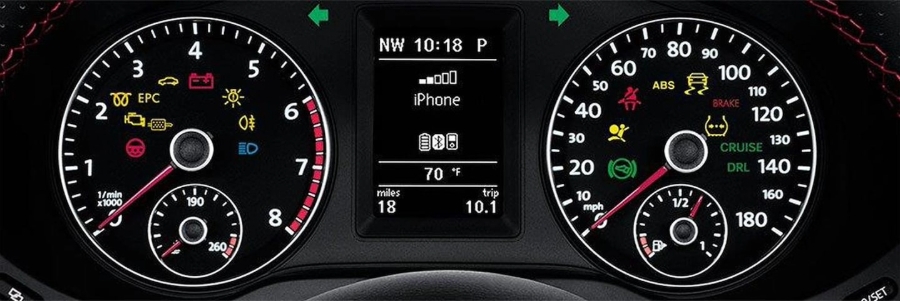
A warning light can appear during a short drive through Queensbury, while merging onto the Northway, or on the way to Lake George. The first question is usually the same: Can I keep driving?
The answer depends on the exact symbol, its color, whether it stays on or flashes, the message displayed in the instrument cluster, and how the vehicle is behaving. Some Volkswagen dashboard warning lights are informational. Others signal a condition that needs attention, while certain warnings mean the vehicle should be stopped as soon as it is safe.
For the meaning of a specific symbol, see our Volkswagen warning-light guide. Then use the steps below to decide what to do next.
Check the Color, Message, and Vehicle Behavior
When a warning light appears, start with three quick checks:
- Color: Red often requires immediate attention. Amber or yellow generally indicates a condition that needs inspection, although some amber warnings can still tell you to stop.
- Pattern: A flashing light may signal a more urgent problem than the same light displayed steadily.
- Vehicle behavior: Shaking, reduced power, unusual sounds, smoke, a burning smell, rising temperature, or changes in steering and braking can make it unsafe to continue.
Read the full dashboard message before deciding whether to keep driving. Instructions can vary by Volkswagen model and model year, so the message shown by the vehicle and the owner’s manual should take priority over general advice.
If traffic conditions allow, take a photo of the warning light and message. That can be useful if the warning disappears after the vehicle is restarted.
What Volkswagen Warning-Light Colors Usually Mean
Color is a useful first clue, but it does not tell the whole story.
| Color | General Meaning | Typical Response |
|---|---|---|
| Red | Immediate action or a potentially serious condition | Follow the dashboard instructions and pull over safely when a critical system is involved |
| Amber or yellow | A fault or condition requiring attention | Read the message first; cautious driving may be possible, but some warnings require you to stop |
| Green, blue, or white | A system is active or displaying its status | Usually informational |
A red seat-belt reminder is not the same as a red oil-pressure warning. An amber stability-control light may flash while the system is actively managing traction, while the same symbol staying on can indicate a malfunction.
The symbol, message, and vehicle behavior matter more than color alone.
Can I Keep Driving With a Volkswagen Warning Light On?
There is no single answer for every warning.
Stop Driving and Pull Over Safely
Find a safe place to stop when the warning involves a system that can affect braking, steering, engine protection, or the drivetrain. Examples include:
- Red engine oil-pressure warning
- Red coolant-temperature or cooling-system warning
- Red brake-system warning
- Serious steering-system malfunction
- DSG transmission overheating warning
- Electric-drive warning instructing you to stop
- Flashing check-engine light with severe shaking, smoke, fuel odor, or major power loss
Turn on the hazard lights and move away from traffic when possible. Do not continue simply because the vehicle can still move.
If the Volkswagen is overheating or its braking, steering, or engine operation has changed significantly, roadside assistance or towing may be safer than trying to complete the trip.
A Short, Careful Drive May Be Possible
Some amber or yellow warnings may allow a limited drive when the vehicle continues to operate normally.
Before continuing, make sure:
- The dashboard does not instruct you to stop
- No critical red warning is present
- The vehicle is not overheating
- Steering and braking feel normal
- There is no smoke, burning odor, or visible fluid leak
- The engine is not shaking or losing substantial power
Even when continued driving is possible, avoid unnecessary trips until the cause has been checked.
What to Do When the VW Check Engine Light Comes On
It depends on whether it is steady or flashing.
Steady Check Engine Light
A steady check-engine light means the vehicle has detected an engine-control or emissions-related malfunction. The Volkswagen may still drive normally, but the issue should not be ignored.
Possible causes can include:
- An improperly secured fuel filler cap
- Ignition-system problems
- Fuel-delivery issues
- Air-management faults
- Sensor problems
- Emissions-control components
The light alone cannot identify which part is responsible.
If the vehicle runs normally and no critical warning is present, check that the fuel filler cap is secure. If the warning stays on or returns, diagnosis is the next step rather than waiting for another symptom or the annual New York inspection.
Flashing Check Engine Light
A flashing VW check engine light is more urgent because it can indicate an engine misfire.
Reduce speed and engine load, and avoid:
- Hard acceleration
- High engine speeds
- Towing or heavy loads
- Continuing a long trip
If the engine shakes, loses significant power, produces smoke, or gives off a strong fuel odor, pull over safely and stop driving.
Even without those symptoms, a flashing check-engine light should be checked promptly because continued driving may cause additional damage.
Common Volkswagen Warning Lights and the Right Response
| Warning | What to Do |
|---|---|
| Red oil-pressure light | Stop the engine and do not continue driving |
| Red coolant warning | Pull over safely and follow the dashboard instructions |
| Brake-system warning | Stop if braking feels different or the display tells you to stop |
| Steady check-engine light | Arrange diagnosis soon |
| Flashing check-engine light | Reduce engine load and seek prompt service |
| TPMS light | Check the tires and follow the displayed message |
| Airbag warning | Have the system inspected promptly |
| Electric-drive warning | Follow the dashboard message and stop when instructed |
These are common examples rather than a complete list. Volkswagen uses different symbols and messages across models and model years.
Do Not Clear the Warning Before Diagnosis
Turning off a warning light is not the same as fixing the problem.
Disconnecting the battery or clearing diagnostic codes with a scan tool may temporarily remove the warning, but it can also erase information that helps identify when and under what conditions the fault occurred.
Clearing codes can also reset emissions monitors to a “not ready” status. That can create problems during a New York OBD II emissions inspection even if the check-engine light does not immediately return.
A diagnostic trouble code points toward the system that detected a fault. It does not automatically prove that one specific component needs replacement.
What Happens During a Warning-Light Diagnosis?
A proper diagnosis goes beyond reading one trouble code. Depending on the warning and symptoms, the process may include:
- Retrieving stored and pending diagnostic codes
- Reviewing freeze-frame and live operating data
- Confirming the dashboard message
- Inspecting related wiring, sensors, fluids, and mechanical components
- Testing the affected system before recommending repairs
- Verifying that the warning does not return
Routine maintenance can also help prevent some problems from reaching the warning-light stage. The Volkswagen maintenance menu outlines common maintenance items and service needs.
Get Your Volkswagen Warning Light Checked in Queensbury
A warning light should lead to an informed decision, not a guess. Identify the symbol, read the full dashboard message, note whether the light is steady or flashing, and pay attention to how the vehicle feels. Stop driving for critical warnings or serious symptoms, and arrange prompt diagnosis when a fault needs attention.
Still asking, Can I keep driving? Schedule a service appointment online in Queensbury to have the warning diagnosed and determine the right next step.